
SEQUIM, WA—Stephen Fuller’s low register and sparse vocals combine with adventurous strings wafting and tightening, building until what’s beneath bursts to the forefront. “Undertones,” the opening track on Caro Kann’s self-titled debut LP (recorded at Rainshadow in Port Townsend), alerts the listener that something new and enigmatic is happening here.
Conversation starters with creators who are driven by strong personal impulses often fall on deaf ears when they start with “you remind me of…” I take the chance and mention “Undertones” takes me back to 1984 and The Blue Nile’s “Across the Rooftops.”
Fuller takes a listen and responds thoughtfully. “Though I hadn’t heard of The Blue Nile, that comparison is humbling. The tune you shared with us, ‘A Walk Across the Rooftops’ is such a clever mix of funk, jazz, rock, strings, and strong vocals. They use space well and leave room tastefully. It’s a great song. Maybe someday we can sound like that. That said, for vocals, one of my favorite vocalists is Nick Drake. I think he makes me feel almost nervous when I listen to him, nervous in a good way. His songs can make you cry and smile at the same time but most importantly they are authentic. You can feel his melancholy nature just through his tone. Such complexity is hard to capture in a song let alone a record or a career.”

The cover art for ‘Caro Kann.’
Melancholy. Yes. It’s there in Caro Kann. Revealing just enough to paint the fleeting moment, all the while directing the listener’s heart toward contemplation.
“The name Caro Kann is a chess opening, a series of chess moves in a common order that creates a general pattern for how the chess game might progress. Early on when Adam (Amr) and I were jamming we’d thrown around a few ideas for names, but we both found out that we both liked playing chess and that the Caro Kann was the opening that each of us preferred when we played with the black pieces.”
—Stephen Fuller

Caro Kann: L-R Colin Schmidt, Adam Amr, Stephen Fuller.
I’m over my comparison trope. The LP is fresh, delivering its own sounds on its own terms. Fuller says they guided themselves towards that. “We made it a point to not compare ourselves to other musical acts while we were making the album. I think this was sort of accomplished by each of us coming up with our own parts individually without too much assertion about what the other people wanted each other’s parts to sound like. We still did have to rework sections of songs to create fluidity within our arrangements. That said, you could draw some similarities to new wave and post-punk bands, even a touch of grunge at points.”
Formation
Caro Kann consists of members Stephen Fuller, Adam Amr and Colin Schmidt. They all found themselves on the Olympic Peninsula in the town of Sequim, population 8,641. “Caro Kann was formed because I was living in Sequim and had been working on some guitar and bass tunes,” Fuller explains. “Adam moved into the same house where I was living and he was playing drums in another band. We started jamming together a bit and worked out a few songs. We needed another person in the band who was interested in playing both bass and guitar and Colin was playing with Adam in their other band and seemed like a good fit. We invited him to come jam with us and that was it.”
The second track on the LP is “A Night Too Soon.” Fragile, pensive, bravely intimate. Fuller’s vocals soften. The guitars drive the tune forward. Then a beautiful keyboard staircase is circled by spoken word. We are getting so much so early on.
“Our lyrics are vague and sparse, though they are derived from authentic feelings experienced by me over the years,” Stephen reveals. The haunting tone lines up with some of the feelings that I was attempting to express, maybe described as though some ghost is sort of following you around and you are trying to run away from it but you can’t quite shake it.”
“The lyrics for the album came pretty late in the process of each song. In general, the music came first and the lyrics were added again as a means to complement the space left in the instrumentation. Partially by choice, and partially due to a lack of confidence in vocal ability. Because the singing and lyrics were written later in the process, it feels oftentimes as though there is a call and response between the music and the lyrics. They work together and separately at the same time.”

Stephen Fuller. (Photos from CaroKannBand.com)
Rhythm
I am drawn to melody. A complete absence of it usually has me reaching for the off button. Caro Kann is less interested in delivering that to me. Somehow though I am more intrigued than put off.
“Melody is an area we could explore a little more,” says Fuller. “The three of us are most naturally interested in rhythm and so the melodies sometimes take a back seat to the driving rhythm in the songs of this LP. That said, the sort of repeated half melodies create a certain curiosity and tension in the listener while also leaving something for the listener to remember. I guess I am considering the choppy guitar riffs in ‘Night Too Soon.’ The guitar riffs sound incomplete in a sense, but with repetition it almost becomes meditative. The incompleteness of each melody is resolved with effectively a new incomplete melody in that song.”
Fuller may admit to a lack of confidence in his vocals, but by track three, the amazing “The Earth, It Moves,” the listener has no such thought. A swirl of suggestion…a combination of images, called forth by Fuller’s delivery bouncing off and around the instrumentation. This one captures not only the band’s dance to balance vocals and sounds, but also the human dance to balance the raw inundating feel of truly sensing each new day…followed by the natural protective mechanism to not get overwhelmed. Some call it “down time.” “We go up, we go down…” and another day is over.
Process
Artists catch the tides of inspiration and emotion as they ebb and flow. Inventiveness increases the chances of something meaningful being born. “Traditionally, my creative process is driven by trial and error,” says Stephen. “Just a willingness to pick up an instrument and sound like shit for a long time until maybe something interesting comes up which still probably sounds like shit until Adam and Colin get their hands on it. The trial and error probably stems from a general boredom. If I’m bored, my first thought is to pick up a guitar or bass and get lost in some fantasy world.”
“Scratch My Back” and “The Fog” deliver ten minutes of searching tension seething just below the surface. You could lose your audience at this point of a record. Instead the deep cuts feel primal, ears left clutching to the moment…head nodding at the band’s choices. The scream in “The Fog” flies from Fuller’s throat as a well-earned release.
It’s not a mark against street cred to cover or copy from your own sound.
“A lot of the songs on the record are derived from other songs on the record,” Fuller admits. “Like, maybe I was fiddling around with a riff and made a mistake and that mistake turned into an interesting hook or melody or bass line or lyric which started an idea for another song. I think maybe that is part of what gives the album some sort of cohesiveness, though there is still a healthy amount of variety particularly considering the relatively minimal instrumentation and vocals.”

(Photo from Instagram)
Collaboration
“This was a highly collaborative LP. Typically Adam and I work out a version of a song where Adam comes up with his drum part and he might suggest some breaks or structural changes. In general, when Adam and I work out our arrangements of the songs we are always considering where there is room for Colin to be creative on either bass, guitar, or synth depending on what he plays for the tune. Incorporating everyone’s creativity was a virtue for this record and that is how I’d like to continue to work on music.”
“In our recording in the studio, the bass, drums, and guitar are all recorded live together which worked well. There is a flow that could be lost if they were recorded individually, particularly in ‘Undertones’ and ‘You there with me’. While the vocals were recorded separately from the guitar, drums, and bass, we recorded the vocals as one take for most of the songs on the record. In this case recording the vocals as one take wasn’t too difficult as the vocals are minimal. For me, the fewer overdubs a recording has in the vocals, the more authentic it seems as it is genuinely one performance and one string of feelings expressed by a vocalist. That is not to say that recording vocals as one take is right or wrong, it is just the way we chose to do it except for a couple of lines.”
“Is That Your Pulse?” ambles in bringing with it heavier guitar work and some swagger. Caro Kann are a force working together.
“The instrumentation for basically every song by and large started with guitar, bass, drums, and vocals,” Fuller continues. “We’d add layers in parts of the recording as seemed fit. An example would be the guitar melody in ‘Scratch My back’ that sort of links the first bass hook section with the second bass hook section. Colin added a second harmonized guitar that really works well there in the lead melody.”
“Another example would be Adam’s input on adding auxiliary percussion in ‘You There With Me.’ While subtle, it is powerful. In ‘The Earth, It Moves,‘ the song started with the bass line. I wrote the initial groove and it became a bit of a synthy funk thing towards the end. The bridge portion where the bassline draws out into whole notes was certainly influenced by a band called TV On The Radio, particularly a song called ‘Wolf Like Me.’ I would say the initial grooves or riffs that I write are instinctual and linking them together well is where collaboration amongst the three of us was important.”
The breathy take on “Shall I Write A Poem” is mesmerizing. Stripped down and comfortable enough to share. Take it or leave it. This is our sound and these are our times. The vocal rumble comes next and leaves just as it delivers.
The 8-song LP ends with the track “You There With Me.” Clicking percussion gives way to guitar and Fuller enters with the line “Heaven knows all my love is gone, not forgotten, all my dreams of you there with me…” His tone is all you need to know.
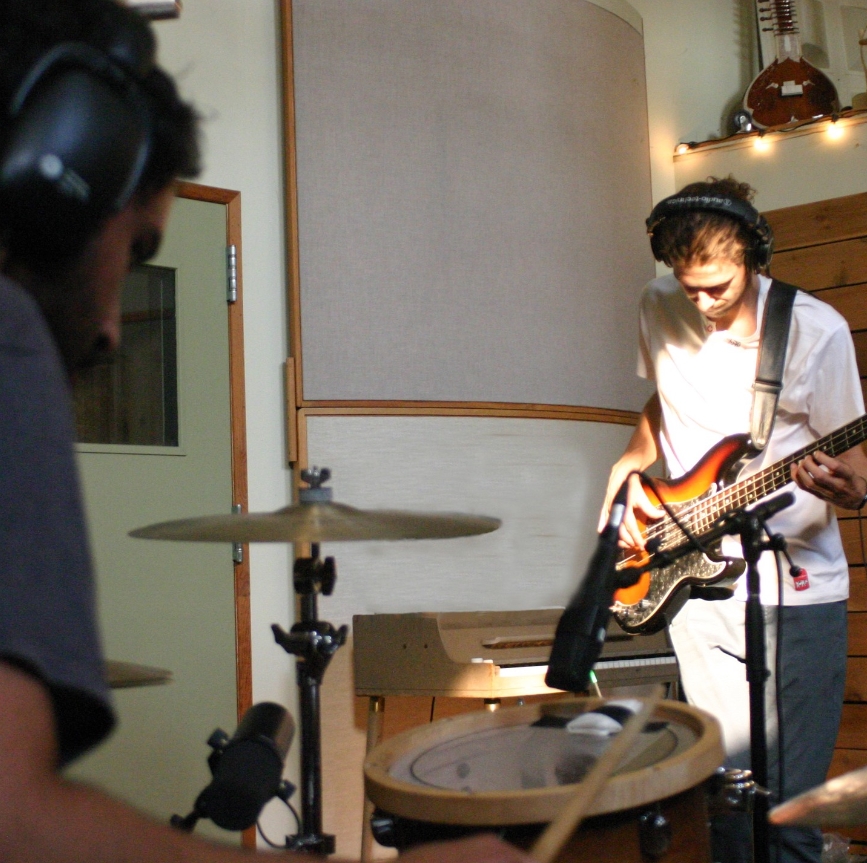
(Photo from Instagram)
‘Caro Kann‘ is raw, emotional, moody, experimental, shrowded in fog but emtionally crystal clear. In your face…while whispering. It’s one of the best new music debuts of the year.
Sequim
All of this, in secluded Sequim.
“The obvious challenge of being in Sequim is that Sequim itself does not have much of a music scene that we fit into,” Fuller says. “There is a bit of a scene in the next town over, Port Townsend, where we have played a couple of shows. We’ve also played a couple of shows in Seattle and a show in Olympia, both of which have venues and scenes where we fit in well.”

“The benefit of living in Sequim is solitude. I think we made a creative record and in our case, the solitude sort of forced us to work without much external influence. That said, being around a variety of creative thinkers is inspiring in its own right. It could be interesting to write a record in a completely different environment, like a city, full of external influence. “
“We are hoping to play some more shows around the Northwest and maybe do a mini-tour in 2024. Other than that, we are constantly messing around with new ideas and it’d be nice to follow up our debut even with an EP or another LP. I think there is room for us to grow.”
Caro Kann Online:
Official Site / Instagram / Bandcamp / YouTube / Facebook
(Cover photograph by Suzanne de Merci.)

UNCLE EARS is a music blog written by David Falk. davidrfalk@gmail.com David was born in 1962 and gravitates towards melodies, adventure, unsigned artists, fresh discoveries. He trusts his ear to know what it likes and loves sharing what he finds. He lives in Port Orchard, near Seattle, WA, USA.
 Uncle Ears
Leave a comment